Happy New Year! I hope that everyone had a really nice holiday break. It’s the heart of winter now, but the days are getting longer, and here at the office of The Cat & The Peacock we’re already busy organizing inn-to-inn hiking tours in Europe for the summer. With that in mind, here’s a shot of one my favorite mountains in the French Pyrenees. This mountain is called the Vignemale, and it straddles the border of France and Spain. As you can see, the north face of the Vignemale is quite spectacular when covered with new-fallen snow. There’s also a small mountain hut at the base of the mountain that serves delicious mountain fare. Interestingly, the first “officially documented” climb of this peak was accomplished by an English woman named Anne Lister and her local guides in 1838. The event was quite a landmark in the history of mountaineering.
The Walliserkanne serves up delicious Alpine fare in Leukerbad, Switzerland
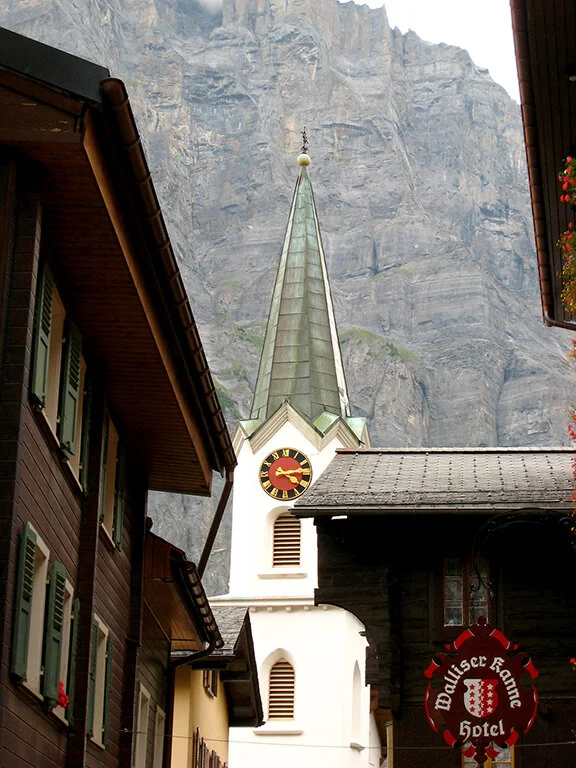
Today I’m corresponding with a guest about traditional Swiss food, and the conversation we’re having has me thinking about this photo. I know what you’re thinking. What does a clock tower have to do with food? Look closely and notice the sign in the lower right corner that says “Walliserkanne Hotel.” That's the De la Croix Fédérale Hotel in Leukerbad, Switzerland. The hotel is cozy, and the food at their Walliserkanne restaurant is off the charts. They have the best Fondue, Raclette, Käseschnitte, and Rösti in the village. They also serve wood fired pizza at their Trattoria, and it’s all dished up in a very traditional, wood-paneled Swiss chalet. I love dining at this place! The building is historic, and the long history of the village permeates the atmosphere. People have inhabited this village for more than 2,400 years. The clock tower/church steeple in the background belongs to the Katholische Kirche Leukerbad (the Catholic Church of Leukerbad).
Swiss Passes make travel SO easy in Switzerland

More Swiss Passes arrived today! That map that you see is a schematic of the entire Switzerland Travel System. Public transport in Switzerland consists of high speed trains, buses, boats, funiculars, cog railways, aerial tramways, and historic lake steamers. It's all accessible with just ONE ticket, making travel in Switzerland SO easy. The guests who we ordered these passes for are going to have a WILD time in the Swiss Alps!
Would you like to explore Switzerland by rail? How about the rest of Europe? I can help.
Mont Blanc used to go by a different name. Here's what it was called.

Standing more than 15,000 feet tall and covered with snow and ice, Mont Blanc beguiles travelers and adventure-seekers from all over the world. But Europe’s highest peak wasn't always called Mont Blanc, the "white mountain." Mountaineers and naturalists gave it the name Mont Blanc in the late 18th to early 19th century, a period known as the “birth of alpinism.”
For extra credit, what was the name of this famous mountain before climbers and adventure-seekers started flocking to the region, say, in the year 1598?
Don’t look at the answer.
Seriously. Don’t cheat.
Do you give up?
Mont Blanc was originally called Montagne Maudite, the “Cursed Mountain.” Incidentally, one of my favorite beers is called Maudite. It’s brewed by the Unibroue Brewery in Chambly, Quebec, Canada. The beer is named after the Legend of the Flying Canoe, a topic that we’ll write about in a future blog post.
Bonne Journée!
Galloping Geese Reunited Again After 67 Years at the Ridgway Railroad Museum

Well, THAT was fun! This past weekend we volunteered with the Galloping Goose Historical Society for an inaugural event called the "Gathering of the Flock" at the Ridgway Railroad Museum in Ridgway, CO. The Ridgway Railroad Museum has a half mile loop track on a 16 acre site that is perfect for running narrow gauge gasoline-powered railcars like the Galloping Geese. Here's a shot of the railcars queuing up for a parade. From right to left are a Rio Grande Southern Railroad (RGS) Model T inspection car, RGS Motor No. 1, Galloping Goose No. 4, and Galloping Goose No. 5. Galloping Goose No. 6 is out of the picture on the left hand side. The fact is, there were more machines than I could fit into my camera frame which is a very good problem to have! What’s the difference between a Motor and a Galloping Goose? Click here for a brief history of the Rio Grande Southern Railroad and the Galloping Geese.
Our group, the Galloping Goose Galloping Historical Society, transported Goose No. 5 from Chama, NM where we’d just finished up a week of excursions on the Cumbres & Toltec Scenic Railroad (C&TS). See our post titled, Riding Galloping Goose No. 5 on the Cumbres & Toltec Scenic Railroad is something everyone should do at least once in their lives. Once in Ridgway, we gave nearly 500 passenger rides during the weekend! That’s FOUR TIMES the amount of rides that we typically give during a week of operation on a railroad like the C&TS! People flew in from all over the country to ride these whimsical machines.
Highlights: Galloping Goose No. 4 made a special trip from Telluride, CO and Goose No. 6 came all the way from the Colorado Railroad Museum in Golden, CO. This was the first time that the Galloping Geese had been back together in Ridgway, where they were originally built, in nearly 70 years. The weekend was a hoot, and we hope to do it again next year!