User-agent: GPTBot Disallow: /

Will I need a Visa to visit Europe in 2021? Not exactly. Here’s what you need to know.

Neuschwanstein Castle, Bavarian Alps

Neuschwanstein Castle, Bavarian Alps

At the end of 2022 all US citizens and as many as 60 other nationalities will need to apply for an ETIAS Visa Waiver before traveling to Europe.

What is it? 

The new travel authorization for Europe is called an ETIAS (European Travel Information and Authorization System) Visa Waiver. If you are a US citizen and you intend on visiting a country within the Schengen Area (Europe) for pleasure or business, then you need this authorization.

I think I missed a day of class. What is the “Schengen Area?”

The Schengen Area is a travel zone in Europe. It’s a region consisting of 26 European states that functions as a single jurisdiction for international travel purposes. All 26 countries share the same visa/travel policy. Switzerland, France, Austria, Germany and Italy, for example, are members of the Schengen Area. Having one recognized zone allows for unrestricted travel between countries. In short, the Schengen Area is what allows a person to land in Paris, for example, and then travel to Rome without having to show a passport while crossing borders.

Note: EU countries, Bulgaria, Romania, Croatia, Cyprus, and Ireland are not part of the Schengen Area, and have their own regulations regarding travel authorizations.

 Please contact us for a full list of Schengen Area countries. 

Who will need the ETIAS? 

Anyone living outside of the Schengen Area. This means that EVERY US citizen planning to visit Europe, including children, will need an ETIAS.

Is it a Visa? 

No. It’s called a Visa Waiver for Europe. It’s basically pre-screening process. If you don’t pass the pre-screen, then you’ll be denied entry to Europe.

When does it go into effect? 

At the end of the year 2022.

How long is it valid? 

The ETIAS is valid for three years or until the end of validity of the document the ETIAS was registered under, whichever comes first. For example, if your passport expires within a year, then your ETIAS will also expire in a year. Otherwise, once you have your ETIAS you can travel to Europe as much as you like during its period of validity (a max of three years). Bear in mind, however, the ETIAS is designed for short-term stays up to 90 days within the validity period. People who wish to live, study or travel in Europe for more than 90 consecutive days will need to apply for a visa. 

How much does it cost?

The particulars are still being worked out, but the anticipated cost for the ETIAS is 7 Euro for each application. Persons under 18 will not have to pay any fees. Therefore, two adults over 18 years of age would pay 14 Euro (about $16 US at today’s exchange rate). 

Am I being discriminated against?

Not at all! The ETIAS is designed for ALL countries that have been able to enter the Schengen Area without a visa. Currently there are 60 countries that will need to apply for the ETIAS. Please contact us for a full list.

What do I need to register?

You’ll need a valid passport, a credit or debit card to pay the fee, and an email account. The whole process should take about 20 minutes. You’ll be asked to enter your passport info and answer a few security questions. 

The process is complete when the travel authorization for Europe has been paid. Confirmation for the ETIAS visa waiver will arrive by email. You can travel to Europe once you have your ETIAS visa waiver in hand! 

Note: Your passport must be valid for 3 months beyond the period of intended stay of each person. 

Please check back for updates as the ETIAS launch approaches.

Are you thinking about traveling to Europe? We can help.

Note: The original version of this post listed January 1, 2021 as the start date for the ETIAS Visa Waiver. The start date has since been postponed and this blog post updated accordingly. Please check back often or contact us for the most up-to-date information.

Look What Arrived Today—A Box Full of Swiss Chocolates!

Swiss Chocolates.jpg

Look what arrived today! Every few weeks I attend a training session hosted by Switzerland Tourism. At the end of each session is a short quiz and a drawing to win a “Swiss Surprise Box.” Well, I won! Look at all that chocolate. I’ve eaten four pieces already! I love the “typically Swiss” goodies too. Do you see that cow in the upper left hand corner? I have a slightly larger version that I picked up on a trip a few years ago. I always wished my little cow had a friend, and now she does. The sales manuals are always much appreciated too. That Swiss Travel System map in the center is a tool that I use almost daily. My maps are quite worn out by the time I get through with them. Anyway, what a wonderful mid-week treat! Thank you Switzerland Tourism!

This Journey Begins with the Matterhorn

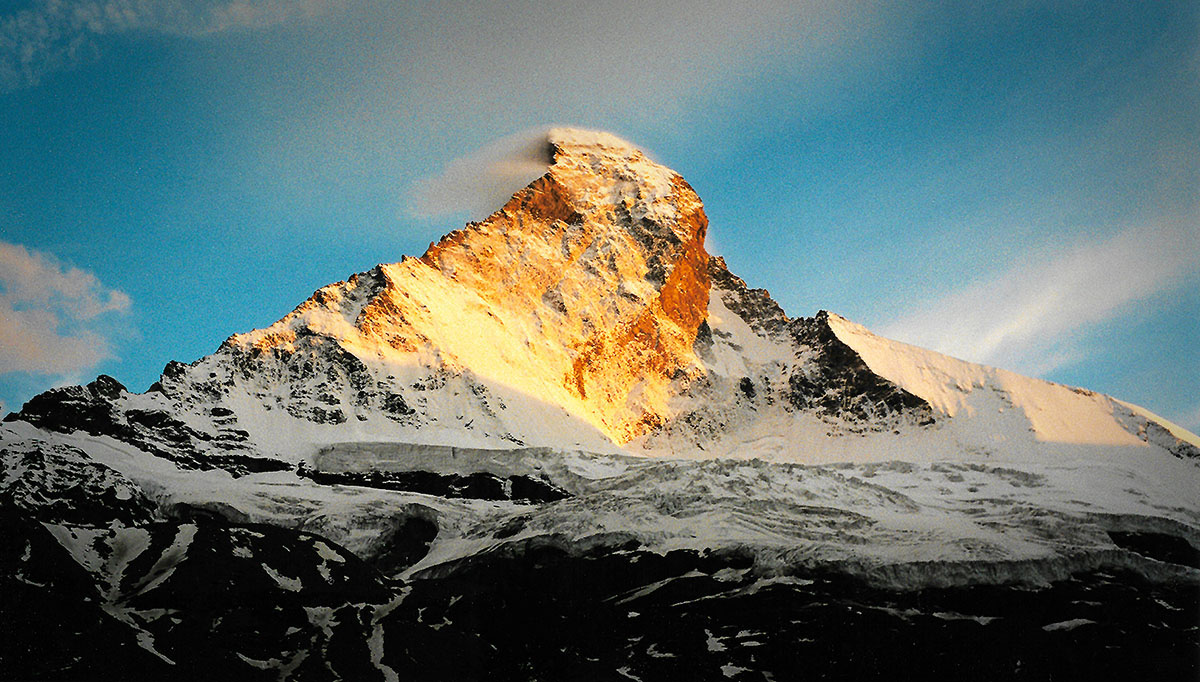
Sunset on the Matterhorn.

Sunset on the Matterhorn.

More than 20 years ago, a friend and I hiked a trail above Zermatt, Switzerland called the Höhbalmen. We didn’t know it at the time, but the Höhbalmen is one of THE BEST hikes a person can do in Zermatt. The Höhbalmen trail offers a full day of hiking, and it has everything that a person could want from a demanding day hike in Switzerland. Big Matterhorn views? Check. Historic mountain inns serving refreshments-with-a-view? Yes! Rolling alpine meadows carpeted with orchids, alpine asters, rare grasses and the elusive Edelweiss flower? Absolutely! The Höhbalmen has it all. The Höhbalmen hike does a big loop above Zermatt passing snow-capped peaks, glaciers, tumbling waterfalls and endless photo-stops along the way. In short, the Höhbalmen hike is outstanding! 

It was while hiking the Höhbalmen trail that I shot the above photo of the Matterhorn and began to ponder a life devoted to Europe and the Alps. As I watched the last rays of sun (commonly referred to as “alpenglow”) bathe the Matterhorn’s north face, I reflected upon the scenery of the day and retraced the Höhbalmen hike in my mind, step-by-step. There’s an old cliché that says hindsight is 20/20. Indeed. Little did I know then that the Höhbalmen trail would provide a direct link to where I am now.

The Höhbalmen in Detail

View of the Matterhorn from the trail above Zermatt.

View of the Matterhorn from the trail above Zermatt.

Beginning in the center of Zermatt, the Höhbalmen trail climbs through a pleasant forest of larch pine, switchbacking alongside a cascade of snowmelt called the Triftbach. The trail eventually emerges above tree line in a high alpine valley at a place called Trift. There’s no town at Trift, just a softly flowing stream, a few grazing sheep, and a historic guesthouse called the Hotel du Trift offering phenomenal views. If the weather is good, a hiker can order a beverage at the hotel, have a seat at one of the outside tables, and gaze across the Mattertal (the valley that Zermatt sits in) to the Dufourspitze, the highest summit in Switzerland at 15,203 feet/4,534 meters. Trift is a peaceful but rugged place. An avalanche took out the first Hotel du Trift in the late 1800’s, so the owners built a second, identical one in 1900. A hiker could easily end their journey at the Hotel du Trift and return home with wonderful stories, but the Höhbalmen trail doesn’t end at Trift. The journey is only just beginning. 

Leaving Trift, the Höhbalmen trail crosses a small wooden bridge and climbs a grassy slope in a south then westerly direction. In about an hour, the trail levels off on a treeless mountain bench called Höhbalmen, the namesake of the trail. On a clear day, the Matterhorn bursts into view. Known as Matterhorn in German, Mont Cervin in French, and Monte Cervino in Italian, the pyramid-shaped mountain that graces so many touristic brochures throughout Switzerland ceaselessly inspires wonder and awe. Some people call the Matterhorn “the most photographed mountain in Switzerland.” The Matterhorn is just a brushstroke, however, on a much larger canvas of mountains. From a vantage point on the Höhbalmen, a hiker can see an imposing wall of 4,000 meter peaks, and the Matterhorn is just one peak out of many.

Beginning with the Matterhorn and working to the left, a hiker with a keen eye can spot the Breithorn (13,661 feet/4,164 meters), Pollux (13,425 feet/4,092 meters), Castor (13,871 feet/4,228 meters), Lyskamm (14,852 feet/4,527 meters), and the Monte Rosa massif (15,203 feet/4,634 meters), just to name a few. The Monte Rosa massif is a collection of 10 main summits (including the Dufourspize mentioned earlier) and is the second highest mountain in the Alps after Mont Blanc. If you continue looking left from the Monte Rosa then you can see the Weissgrat (literally, the “white ridge), with it’s Gornergletscher (Gorner Glacier) descending like a giant tongue of ice. You can also spy the Rimpfischhorn (13,776 feet/4,199 meters), Allalinhorn (13,212 feet/4,027 meters), Alphubel (13,799 feet/4,206 meters), Täschhorn (14,734 feet/4,491 meters) and the Dom (14,911 feet/4,545 meters). This last mountain, the Dom, is an interesting character. While it’s true that the Dufourspitze is the highest summit in Switzerland, it shares a border with Italy so it’s not entirely in Switzerland. The Dom, by contrast, is the highest peak completely residing within Swiss territory. 

As if the Swiss mountain views weren’t enough, the Höhbalmen viewpoint is typically filled with all types of wildflowers including the famous Edelweiss. The local tourism bureau advertises the Höhbalmen trail as the “Edelweissweg” (the Edelweiss path) and they’re right to do so. If alpine wildflowers are your thing, then the Höhbalmen is for you. Continuing along the Höhbalmen, the views just get better and better. Straight ahead you can see the Tiefmattengletscher and Stockjigletscher (two sparkling glaciers) spilling down at the end of the valley.

The pint-sized village of Zmutt on the Höhbalmen trail above Zermatt.

The pint-sized village of Zmutt on the Höhbalmen trail above Zermatt.

Eventually, the trail descends through a striking mountain landscape with misty waterfalls, ancient farmsteads, more views of the Matterhorn, and the highest mountains in Switzerland the entire way. On its return journey to Zermatt, the Höhbalmen trail passes a tiny mountain hamlet called Zmutt. Zmutt is just a pint-sized cluster of wood and stone houses huddled together in a mountain valley. Zmutt is cozy and a great place to get out of the weather and grab a warm beverage if conditions turn sour. It’s also a nice place for refreshment on a sunny day too! From Zmutt, the trail passes ancient granaries (called Mazots) and traditional farming chalets before returning to Zermatt. 

The village of Zermatt with the Matterhorn looming in the background.

The village of Zermatt with the Matterhorn looming in the background.

As my mind returned to the sunset on the Matterhorn and I watched the soft rays of alpenglow play across the mountain’s northern flanks, I thought about how pleasurable it would be to spend a life exploring sunny alpine meadows and rugged mountain peaks. That was more than 20 years ago! Little did I know that I’d spend the next 18 years organizing inn-to-inn hiking tours in the Alps and showing countless curious people wonderful places to explore in Europe. Fast forward a little bit more, and here we are, penning the inaugural blog entry for The Cat & The Peacock—Distinctive Travel For Curious People.

Parting Thoughts

There is an idea in quantum physics that the world is filled with multiple realities all coexisting at the same time. In one world, for example, you are a doctor. In another you’re an engineer. In other worlds you’re a celebrity, an artist, a baker, a filmmaker. These realities, (some would call them possibilities), all exist concurrently in their respective worlds. It’s up to you to pick one and make it a reality in the here and now. In my case, I picked a life spent with the Matterhorn and I haven’t looked back since. 

Would you like to go hiking in Switzerland? We can help.

Photos by Chris Pranskatis.