This is the Oeschinensee, one of the most beautiful mountain lakes in the Swiss Alps, and one of our favorite stops during our 9-day inn-to inn hike through the Berner Oberland. The hiking day is a big one. We begin in a remote valley called the Kiental and climb 1,370 meters (nearly 4,500 feet) to the 2,778 meter-high Hohtürli pass. A side trip at the pass takes us to the dramatically situated Blüemlisalphütte (2,840 meters) which serves one of the best Käseschnitte (Swiss cheese on white wine-drenched toast), that you’ve ever tasted. Accompanied by an optional (but highly recommended) glass of Schnapps, the Käseschnitte is especially warming on a rainy or snowy afternoon! Following lunch, we descend past the beautiful Oeschinensee (Oeschinen Lake) and finish in the tranquil Swiss village of Kandersteg. The hiking distance for the day is around 17 kilometers/10 miles with 1,450 meters/4,757 feet of ascent and 1,700 meters/5,577 feet of descent.
Can’t travel because of a pandemic? Here are 5 travel-related activities you can do instead.

Looking through the glass clock at the Musée d’Orsay in Paris, France.
Take a Virtual Tour
Is there a place that you planned on visiting but can’t because of the pandemic? No worries! There’s a good chance that you can tour the destination virtually. As of this writing, we found online virtual tours for the Vatican, Buckingham Palace, the Natural History Museum in London, and one of our favorite museums in Paris, the Musée d’Orsay. In truth, we found A LOT of virtual tours—too many to list here. You can even take a trip to the top of Mont Blanc! Here’s a tip: Do an online search for a destination that interests you and include the key words “virtual tour” to see what pops up. The really good tours, like the Musee d’Orsay, let you wander hallways, zoom in on artwork, and click on objects to learn more.
Would you like to be overwhelmed? Check out the Goose Arts and Culture page. Googe A&C has enough content to keep you occupied for weeks!

Fond memories of trails hiked and mountains climbed.
Organize Stories From Past Trips
Raise your hand if you have a million travel photos stored on your phone or computer. What about old journal entries that you secretly hoped to turn into a memoir, novel or blog, but didn’t? A quarantine is the perfect opportunity to bring those treasures to light. Turn some of those photos into greeting cards. Make a calendar. Build a website that showcases your greatest work. Start a blog. If you ever wanted to write a book about your past travels or do something creative with your millions of travel photos and journal scribblings, a quarantine is a great time to do it!

Chalkboard menu at a French crêperie.
Learn a New Language
It’s not necessary to know the local language when you’re traveling in a foreign country, but it certainly makes the experience easier and infinitely richer. Even if you never become fluent, just the simple act of saying hello in a person’s native tongue will go a long way toward building relationships and breaking down cultural barriers. There are a ton of language learning books and apps on the market, and one of our favorite free apps is DuoLingo. You probably won’t learn to speak like a native with this app (it’s heavy on direct translation from reading and listening), but you’ll get a good dose of vocabulary. We recommend supplementing DuoLingo with a more formal program like Living Language, Berlitz or Rosetta Stone. At the time of this writing, Rosetta Stone is offering a free 3 month trial for students. YouTube can also be a good resource. For intermediate and advanced learners, online foreign newspapers are a gold mine for learning. Google books also offers downloadable versions of many foreign language literature classics. The point is, put your self isolation to good use by learning a foreign language. Who knows? Maybe you’ll be able to say “soup du jour” like a native-speaker the next time you visit Paris.

Simple pleasures.
Read A Book
Few things are cozier than curling up on the couch with a comfortable blanket, a warm cup of tea, and a good book. Books take us around the world, and they offer a level of richness, perspective, and detail that we’ll never get from a 50 word post on social media. The death of the book has been much publicized, but we we’re not convinced that books will ever go out of style. Try it for yourself. Shut off the electronic devices, open a book, and let yourself be transported to distant lands. Right now we’re reading a book called “A History of Mountaineering in the Alps” by Claire Eliane Engel. The book was published in 1950 and chronicles the pioneers of mountaineering and tourism in the Alps, many of whom were not climbers as befits the status today. It’s hard to imagine, but there used to be a time when people were not at all interested in climbing mountains for pleasure. Many of the first “alpinists” were, in fact, scientists, and their most important piece of climbing equipment was not the rope, but the barometer. Would you like to know more? Contact us. We’ll recommend some destination-specific books.
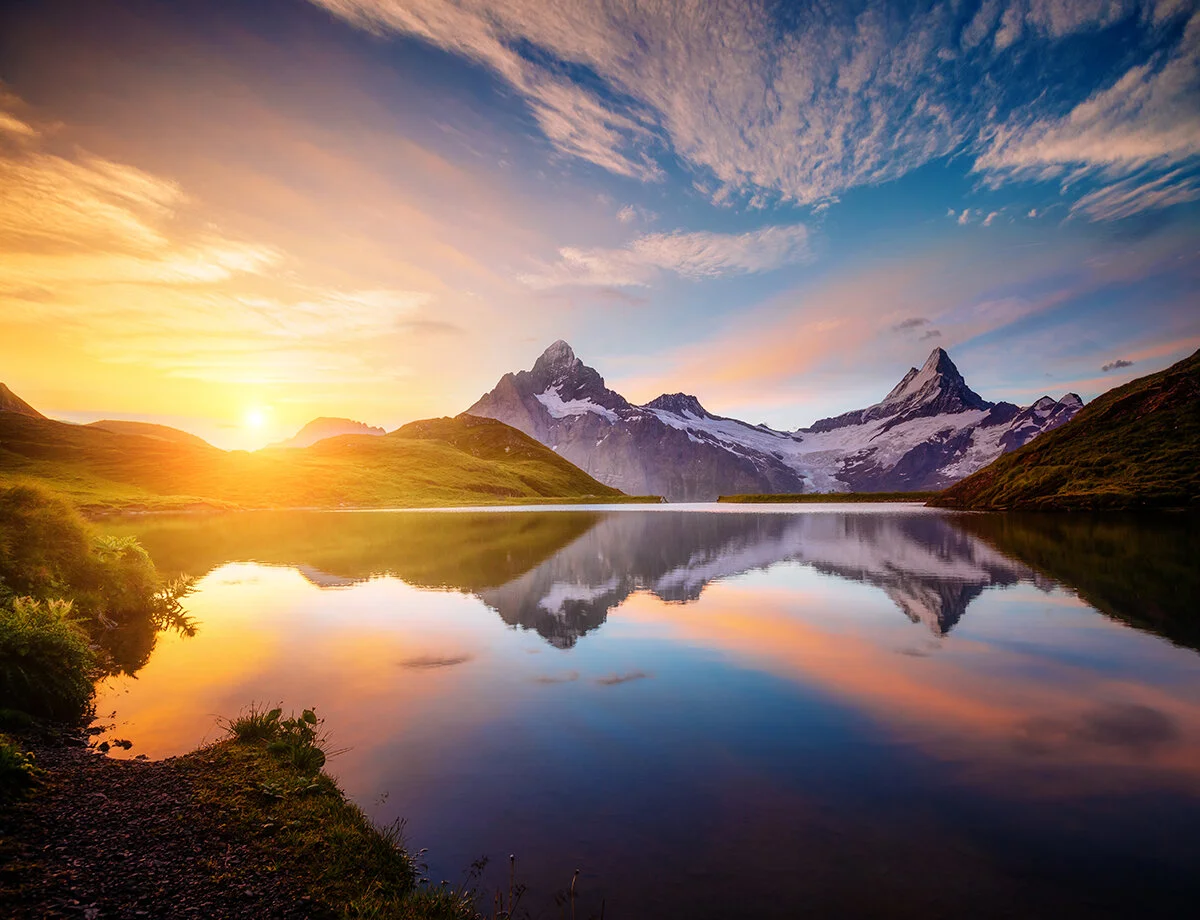
Sunrise over the Bachsee in the Berner Oberland region of Switzerland.
Dream Now. Travel Later.
Losing your job during a quarantine is no fun. We get it. But have faith, the pandemic won’t last forever. Plus, there’s absolutely no cost for dreaming and planning. Is there a place that you’ve been curious about? Please give us a call or send us an email. We love chatting about far-flung lands. You can also use our online questionnaire to get the conversation started. And don’t worry, our tips and chats are absolutely free. No mask required either!
A Quiet Path for Disquieting Times
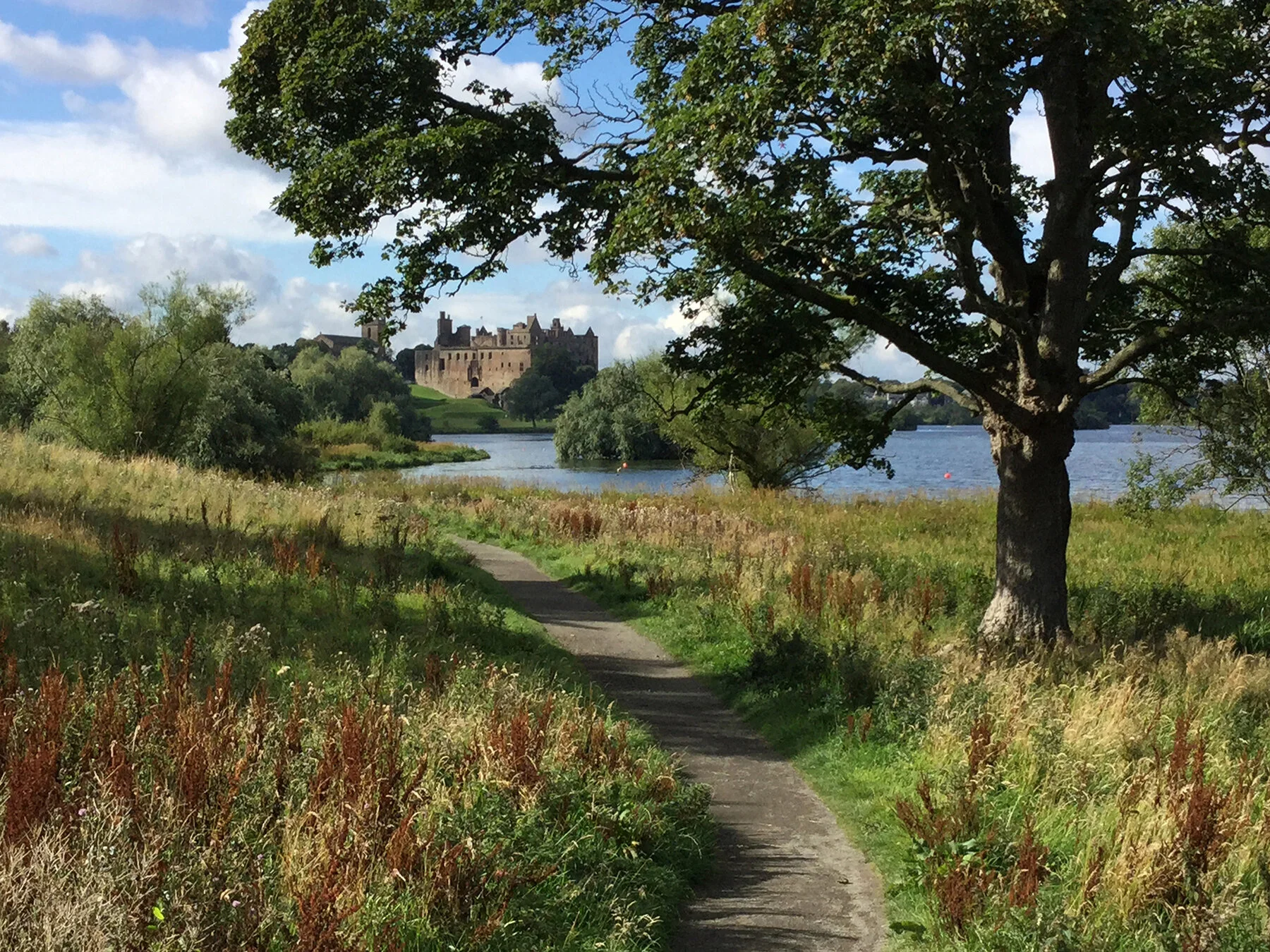
Quiet paths can be healing, and they’re good for the soul. Here’s one of our favorite quiet paths in the little town of Linlithgow in West Lothian, Scotland. The castle in the background is Linlithgow Palace. As in most parts of Scotland, there is A LOT of history surrounding that castle. The lake on the right is Linlithgow Loch. We may not be able to travel at the moment, but the natural world is still out there sharing her love and healing energy. We hope this photo brings you a bit of comfort and peace during these very disquieting times. Stay positive, and stay safe.
Eating & Hiking Our Way Across the French Basque Country

The vineyard covered slopes of Irouléguy.
We’ve cooked up a really wonderful inn-to-inn hiking tour in the Pays Basque (the French Basque country). Let’s lift the lid a little and see what’s inside.
The Basque hills are a landscape painter’s dream. Windswept peaks and ridgelines melt into vineyard and pasture covered hills which in turn relax, stretch out, and spill their beechwood forests and trout-filled streams into the sea. Along the Bay of Biscay, village fisherman still fill their tiny boats with tuna, cod, anchovies and sardines, while waves crash against rocky cliffs and then are gently calmed by sandy, crescent-shaped beaches. Along the shoreline, cheerful little ice cream carts selling “glaces et sorbets artisinales” await. In the mountains, the calming bleat of a sheep betrays the village sheepherder who, often wearing a traditional beret, contently manages the flock. Meanwhile, pottok (wild Basque ponies) graze nearby. Through all of it, the most perfectly sketchable villages lurk over every hill top.
The region between the town of Pau and the Atlantic Ocean is often considered the most picturesque region of the Pays Basque, beguiling travelers with tranquil villages that time has seemingly forgotten. The centerpiece of these villages, and of Basque culture in general, is the farm house, with its broad terracotta tiled roofs, neatly whitewashed stone facades, and exposed timber frames. The wooden timbers and shutters on these homes are always painted a deep, seductive red. In the fall, ristras of red pepper hang-dry from the woodwork of these cute country homes. The peppers are a spicy decoration produced in one of southern France’s prettiest towns, the village of Espelette.

The celebrated piments d’Espelette.
Pepper from the village of Espelette, known locally as piment d’Espelette, is more than just a decoration in the Pays Basque. Fine cookery is a source of local pride in the Basque hill country, and the Basque people are masters of infusing the piment d’Espelette into the most delicious and mouthwatering cuisine. The pepper infused dark chocolate is worthy of investigation! Indeed, the Basques seem to be born with an innate sense of good cooking, probably due in large part to the location of the Pays Basque between the mountains and the sea. Situated “au bord de la mer,” as the French like to say, the Pays Basque benefits from an abundance of treasures from the sea and mountain farms alike.
Taste, for example, the ttoro (pronounced tioro), a traditional fisherman’s stew. A specialty of the Basque coast, ttoro was originally prepared by fisherman in the middle of the sea, on their fishing boats, with fish that had been discarded from the net. Ttoro features a blend of fish including, but not limited to, monkfish, prawns, eel and mussels. More of a stew than a soup, ttoro is lovingly prepared by the fisherman’s wives who blend the stew with tomato sauce, garlic, and the famous Espelette pepper.
How about sampling the Salamis de Palombe? This dish consists of local wild dove simmered with red wine, diced ham from the nearby town of Bayonne, shallots and a bouquet garni assembled from the most flavorful local herbs. Are you a vegetarian? No problem. A good meal depends on good quality ingredients, and the fertile landscape of the Pays Basque produces the best quality vegetables and fruits in southwest France.

La Pipérade, a traditional Basque dish thoughtfully prepared with onions, bell peppers, tomatoes and piment d’Espelette.
Each village in the Pays Basque takes pride in a particular gastronomic treasure. Just outside of Pau, the region of Jurançon produces wines that have been celebrated since the middle ages. Petit Manseng and Gros Manseng are the principal grape varieties of Jurançon used in both sweet wines (Jurançon) and dry white wines (Jurançon sec). Deeper in the Basque hills, in a vineyard-terraced countryside that spills over into Spain, the commune of Irouléguy produces the preferred red and white wines of the region. Cabernet Franc and Tannat varieties are the principal grapes for the Irouléguy reds, while Courbu, Petit Courbu, Petit Manseng and Gros Manseng are the principal Irouléguy whites.
In the valley of Itxassou, cerises noires (black cherries), provide the sweet foundation of a most delicious confiture which is often used as a filling in the gâteau Basque. The gâteau Basque is a delectable double crust pie, sometimes filled with home-made pastry cream, that goes down far too easily following a traditional Basque meal.

The traditional gâteau Basque.
You would not be alone if you were tempted to drive from village-to-village and eat your way across the Pays Basque, sampling pintxos (Basque tapas) as you go. But that would be a shame because the Basque hill country offers some very delightful hiking and walking trails that are worthy of exploration. Take, for example, the hike across the exposed Crêtes d’Iparla between the villages of Saint-Étienne-de-Baïgorry and Bidarray. On a clear day, you can drink in the views of the Hautes-Pyrénées to the east, the Atlantic Ocean to the west, and a patchwork quilt of idyllic villages and farms in between. You’ll follow the French border all the while, frequently dipping your toes into Spain as you hike.
While the Basque hill country may not be as high as the mountains of the French Alps, some of the trails can be quite steep, leaving even the most ardent hikers pleasantly satisfied. Of course, you’d be foolish not to visit a fromagerie during your hike. Aromatic wheels of fromage de brebis (sheep’s milk cheese) are produced in the beech forests of Iraty and the Ossau valley using a technique that dates back thousands of years. There was a time, centuries ago, when Ossau-Iraty sheep cheese was so valued that it was used as a form of local currency. And just down the road, in the village of Ascain, Monsieur Lagadec has revived an ancient Basque apple wine called Sagarno at the Txopinondo Cidrerie Basque. As with the cheese, you’d be “complètment fou” if you didn’t stop in and “prendre un verre.” Lucky for you, we include these tasting stops in our hike.
Would you like to know more about hiking (and eating) in the Pays Basque? Check out our French Basque Country hiking tour. And of course, give us a call or drop us a note if you have questions. We absolutely love sharing the wonder of this treasured land in southwestern France.
Hiking in Arizona: One of our Favorite Saguaro Cactus Forests Near Tucson

Ok. This is not the Alps, but it’s still pretty cool! I LOVE these saguaro forests in the Sonoran Desert. Some of these cacti look quite lifelike with their two rubbery arms. When the tops of their heads flower in the spring, the cactus “people” look they’re wearing toupees. It’s an awesome sight! We shot this photo on one of our favorite hiking trails just outside of Tucson, AZ.