Here’s the view from the Jungfraujoch, the highest rail station in Europe, elevation 11,332 feet (3,454 meters). The train that brings you to this point climbs INSIDE the Eiger (pictured in our previous post). The view is awesome, and it’s really easy to escape the crowds. A 45 minute walk across the glacier takes you to the Mönchsjochhütte which offers rustic food and accommodation in a gorgeous setting.
Spotlight on our NEW Grindelwald, Zermatt & Chamonix Hiking Tour—Part 1

The Eiger as seen from the Hotel Bellevue Des Alpes at Kleine Scheidegg, Switzerland.
Note: This is part 1 of a 3-part spotlight on our Grindelwald, Zermatt and Chamonix Hiking Tour.
This last month has been busy! Along with the new Swiss Alps ski trip that we introduced in May, we also designed a hiking tour for a 30-something couple that asked us to put together a self guided hike in Switzerland and France. Like the skiing guests, this couple had a few criteria. First, they wanted to see the most stunning mountains in the Swiss and French Alps. Second, they wanted a hearty dose of luxury since this is a special occasion and they don’t get to hike in the Alps every day. Third, they only have a week available, so they wanted maximum value for their time. This couple was also fine with a little busyness in exchange for WOW views. So we mixed everything in our magic beaker and voila, the result is our new Grindelwald, Zermatt & Chamonix hiking tour, a hike we also refer to as the Eiger, Matterhorn & Mont Blanc.

The mountains surrounding the Eiger are stunningly beautiful. This is the view from the carless village of Mürren. From left to right, the mountains in this photo are the Eiger, Mönch and Jungfrau.
Full disclosure: The towns of Grindelwald, Zermatt and Chamonix, and the Eiger, Matterhorn and Mont Blanc summits that anchor them, are not “off the beaten path.” They’re not “hidden gems,” nor are they the “greatest places you’ve never heard of.” These locations are not “the next big thing” because they ARE the thing, and they played a pivotal role in the history of modern alpine tourism. Mont Blanc, for example, has been attracting alpinists and adventurers to its summit since the late 1700s. The Matterhorn, to cite another example, welcomed famous authors and adventure-seekers like Mark Twain in the late 1800s. Put another way, mountain tourism is what it is today because of these destinations.
So why go then, in this age of endless quests to escape the crowds and find the next best undiscovered spot? The answer is simple. The Eiger, Matterhorn and Mont Blanc are three mountains that everyone should see at least once in their lives. Famous places are famous for a reason, and you’ll feel like you did something special if you stretch your legs along the slopes of these famous alpine giants.
Let’s begin with the Eiger, located in the Bernese Alps (Berner Oberland) of central Switzerland in a sub region of mountains called the Jungfrau. The Eiger is famous because it’s beautiful, and it’s beautiful for a number of reasons. First, the Eiger has the biggest north face in the Alps. North faces are special in the world of mountaineering because, facing north, they are shielded from the sun’s warming rays and are typically the coldest, darkest, iciest and most difficult routes to climb. The Eiger’s north face, referred to locally as the Nordwand, is one of the most formidable in Europe, towering 6,000 feet above the surrounding countryside. The Eiger is also part of a much larger group of mountains and glaciers with notable peaks like the Mönch, Jungfrau, Wetterhorn, Schreckhorn, Grosses Fiescherhorn and Finsteraarhorn. This last peak is the highest mountain in the Bernese Alps at 14,022 feet/4,274 meters. In the center of these mountains exists a fantastical world of glaciers including the largest glacier in Western Europe, the Aletsch.

The idyllic Lauterbrunnen Valley, Switzerland which has inspired artists and writers for centuries. The valley boasts 72 tumbling waterfalls.
All of this rock and ice has a profund effect on the surrounding landscape. The lower elevation countryside is well-watered which makes for a fairytale land of flower-filled meadows, green grass, bubbling streams, cool pine forests and misty waterfalls. It’s a land of profound beauty and inspiration. The famous poet Johann Wolfgang von Goethe composed "Song of the Spirits Over the Waters" while visiting Staubbach Falls, one of 72 waterfalls in the nearby Lauterbrunnen Valley. In addition, the elevation change of the region is striking, which makes for incredible photographs. Interlaken, for example, the jumping-off point for the region, sits 11,000 feet (3,401 meters) LOWER than the summit of the Eiger. The views from the lowlands to the highlands are stunning!
Finally, if you like historic trains and “typically Swiss” architecture, then there’s no better place to explore than the Swiss countryside surrounding the Eiger. The Brienz Rothornbahn steam-powered narrow gauge rack railway (opened in 1892) huffs and puffs above the Brienzersee (Lake Brienz) and offers panoramic views of the entire Jungfrau mountain range. The electrified Schynige Platte rack railway (opened in 1893) departs the village of Wilderswil and climbs at a leisurely 7.5 mph (12 kph) to a mountain-top vantage point that magnifies tenfold the view of the Eiger, Mönch and Jungfrau peaks. The Wengernalpbahn (opened in 1893), touted as the “longest cog railway in the world,” connects the villages of Lauterbrunnen and Grindelwald and carries passengers past idyllic wooden chalets and mountain pastures to the very base of the Eiger at a historic railway station called Kleine Scheidegg. At Kleine Scheidegg, guests descend the train and crane their necks back to examine the Eiger’s 6,000 foot-tall Nordwand. Last, but not least, the Jungfaubahn (opened in 1912) departs Kleine Scheidegg and carries passenger INSIDE the Eiger, eventually dropping them at the Jungfraujoch, the highest railstation in Europe servicing the eight highest railroad in the world.
A person can easily spend a week or more hiking the countryside that surrounds the Eiger, but our new Grindelwald, Zermatt & Chamonix hiking tour also explores the Matterhorn and the region of Mont Blanc which we’ll explore in part 2 and part 3 of this post. Stay tuned…
Check out our NEW 14-day ski & snowboard tour in Switzerland | Adelboden, St-Luc & Pontresina
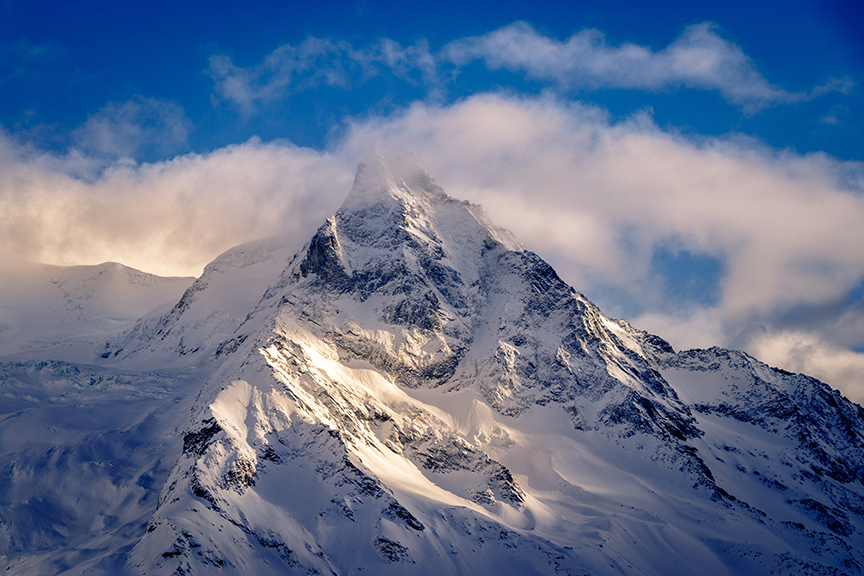
The Pointe d’Ar Pitetta (10,279 feet/3,133 meters) viewed from Zinal, Switzerland.
A few months ago a couple asked me to put together a custom ski tour in Switzerland. The couple had a few criteria. First, they wanted a trip that was off the beaten path with a splash of pizzazz. Second, they are intermediate skiers and they wanted gentler slopes with a nice “Swiss experience.” Third, they wanted to ski Switzerland during the Christmas and New Year holiday and sample three distinct regions. I knew right where to send them, and thus was born the Adelboden, St-Luc & Pontresina Ski & Snowboard Tour.
First, it must be said that picking a ski destination in Switzerland is a lot like choosing from a box of chocolates. It all looks mouthwatering! There are more than 300 ski resorts in Switzerland with more than 4,000 miles (7,000 km) of trails and nearly 2,000 lifts. Of course some Swiss ski resorts are enormous with myriad distractions and trappings while others offer nothing more than a single t-bar for a lift and a barn doubling as a lift ticket window. When someone tells me they want “off the beaten path” the first question I present to them is, “How far off the path would you like to go?” Put another way, “If you were to visit France, would you be happy to come home without ever seeing the Eiffel Tower, or would you like to experience a few popular sights too?” The trick in tour planning is to find a happy balance between something that’s undiscovered and less-touristy, but also fun and exciting with an authentic sense of place. The Adelboden, St-Luc & Pontresina Ski & Snowboard Tour strikes that balance.
On an off-the-beaten-path scale, Adelboden falls somewhere in the middle. The first tourists trickled into the village during the late 1800s, and the floodgates opened in 1902-3 when a British gentleman named Sir Henry Lunn organized the first packaged tours of the area. Adelboden’s fame should have skyrocketed from there, but Lunn also marketed nearby Wengen which, when combined with the villages of Grindelwald and Mürren, fast became a popular ski destination as well. Over time, resorts like St. Moritz, Zermatt and Wengen-Mürren-Grindelwald grew in fame and popularity while Adelboden became the preferred resort for families and visitors looking for a quieter “wellness” experience. The result today is a tranquil Swiss village that feels like it’s off the beaten path but actually has a long history of winter sport tourism. As of this writing there are five Gault & Millau rated restaurants in Adelboden, two four-star hotels and a host of accommodations to suit almost every taste from casual to sophisticated. The one thing that Adelboden does not have is over-the-top glitz. There are no five star luxury palaces, no Michelin-starred restaurants, and no private jets. Adelboden doesn’t have a lot of expert level terrain either unless you do some backcountry touring (which is quite good). That said, the FIS World Cup rolls into town every winter, so Adelboden can throw down when it needs to. In short, Adelboden offers a less-touristy Swiss ski & snowboard experience but still serves up loads of fun for the entire family. Adelboden is one of those warm and cuddly places that steals your heart.

Traditional wooden houses bedecked with holiday finery in the Swiss village of Grimentz.
Moving on from Adelboden, our ski & snowboard adventure enters the Val d’Anniviers, a remote valley jutting straight south of the Rhone River in southern Switzerland. Ten years ago, the Val d’Anniviers would have occupied the higher end of the off-the-path scale (pretty remote). The region wasn’t completely undiscovered, but its slow lifts, small ski areas, and a dearth of sophisticated amenities kept it off the radar for most people. The word started to get out in 2014, however, when the villages of Grimentz and Zinal connected their small resorts by cable car. Skiers and snowboarders took notice. Potential visitors started sniffing around and what they found was a truly authentic area with pristine slopes, pretty little villages forgotten by time, and tons of potential for great skiing and snowboarding. The 15-mile long Val d’Anniviers actually has five small ski areas, Grimentz, Zinal, Saint-Luc, Chandolin and Vercorin. Grimentz and Zinal are connected by cable car. Saint-Luc and Chandolin are connected by chairlift, and Vericorin stands alone. All of the resorts are accessed by a bus system that circulates throughout the valley. When you stand at the foot of the Corne de Sorebois, one of the highest points of the Grimentz-Zinal area, you have a commanding view of the “Imperial Crown,” a circle of mountains containing more than 30 peaks over 4,000 meters tall including the Matterhorn. If the Val d’Anniviers had succeeded in building a railroad like the one that exists in neighboring Zermatt, then the valley would have exploded. (Villagers in the Val d’Anniviers had plans to build a railroad, but the First World War killed the project.) In short, the potential here is huge, but here’s the thing. Many of the lifts are still slow. The amenties are few, and there’s still only one way into this dead end valley—a winding road with enough steep switchbacks to make any acrophobe grumble. I absolutely love it!

The cable car to Diavolezza above St. Moritz & Pontresina.
Finally we transition to the Engadine Valley in eastern Switzerland via the Glacier Express. This is where the off-the-beaten path meter takes a major tumble. The Glacier Express is a world famous train ride, and our final destination, St. Moritz, is widely considered the birthplace of ski tourism in Switzerland. It is definitely not off-the-beaten path. It IS the path. This is ground zero for tourism, but if you like sunny “cruiser” slopes and a high level of gastronomy and innkeeping, then there’s no better place to be. I picked Pontresina as the base for this trip because it’s a restful alternative to St. Moritz which is just 6 km down the road. Pontresina is also conveniently located between the major ski resorts with quick acess to Corvatsch, notable for its striking scenery and a nearly 6 mile-long ski run (9 km) down to St. Moritz. Diavolezza & Lagalb are also just up the road and offer thrilling black runs in a high alpine environment. Corviglia is the resort accessed directly from St. Moritz and offers excellent cruising. Everything exists in this part of Switzerland, from luxurious five star palaces and chic international boutiques to the humble Stüva serving local Engadine specialties. The St. Moritz-Pontresina area is not off-the-beaten-path, but it certainly offers a splash of pizzazz.
Click here to read more about our Adelboden, St-Luc & Pontresina Ski & Snowboard Tour.
Pic of the Day: The Hotel Bellevue des Alpes—a historic gem in the Swiss Alps

The venerable Hotel Bellevue des Alpes occupies a privileged position on the Kleine Scheidegg between the Swiss towns of Grindelwald and Wengen. The hotel dates to 1840 and hosted many of the world's greatest mountaineers during the late nineteenth century. Many celebrities of society, skiing and film have stayed there as well, drawn by the unforgettable beauty of the surrounding landscape. Today, the common areas of the hotel retain 1920s charm and visiting the hotel is like taking a step back in time. The mountain in the background is the Eiger. The Eiger’s beauty attracts visitors from all over the world.
Need a Swiss City Break? Check out the Rathaus Basel

The 500 year-old Rathaus (Town Hall) in Basel.
Here's something that a curious person might like. It's called the Rathaus Basel (Basel City Hall) and it's one of the more intriguing buildings in the city of Basel, Switzerland. Built in the early 1500's, the Rathaus is more than 500 years old. I love the eye-catching red color and the intricately detailed frescoes. I'm also a sucker for medieval clocks like the one stuck to the outside of this building. While the Rathaus may not appear extravagant (compared with other European buildings), it's richly decorated inside and certainly worth a visit.
Photo by Chris Pranskatis.