It doesn't get much better than this! On the hiking trail from Chamonix, France to Zermatt, Switzerland. That's Mont Blanc in the background, the highest mountain in Western Europe at 15,781 feet (4,810 meters). You can enjoy this view on the Hiker’s Haute Route and Tour Mont Blanc.
5 Fun Facts About the Swiss Flag
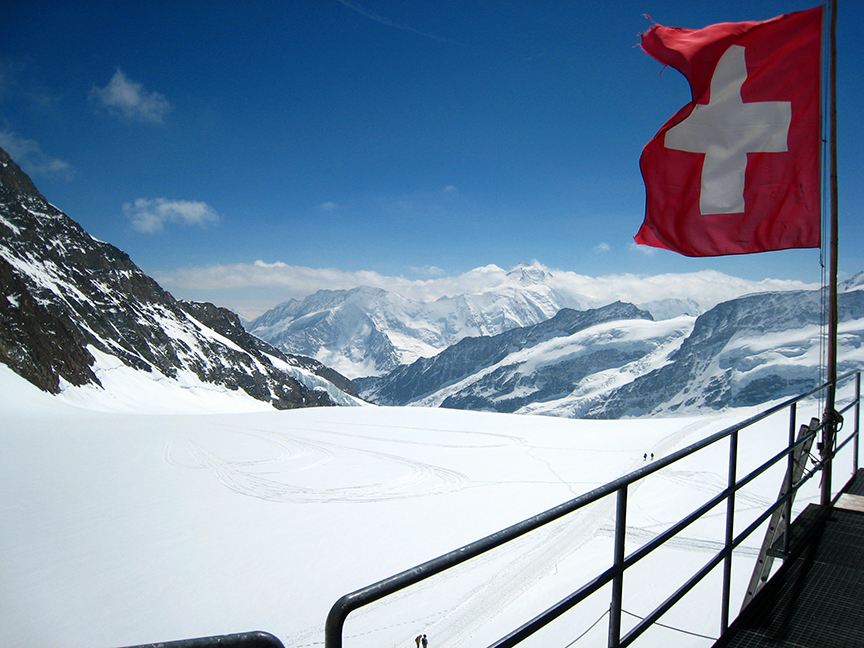
The Swiss flag flies proudly at the Mönchsjochhütte in the Jungfrau region of Switzerland. This is the view looking down the Jungfraufirn toward the Konkordiaplatz in the high Swiss Alps.
In early August 1291, three alpine cantons, Uri, Schwyz and Unterwalden, signed a treaty of allegiance with each other that is widely regarded as the official founding of Switzerland. In honor of that day, we’ve posted five fun facts that you probably didn’t know about the Swiss flag.
1. The Swiss flag is nearly 700 years old.
Switzerland’s white cross (the Swiss Cross) on a red background dates to the Battle of Laupen which occurred in 1339 in the canton of Bern. Legend has it that Swiss soldiers, fighting for the Swiss Confederacy, sewed a white cross onto their banners and armor to distinguish themselves from the enemy. Eventually, the white cross was adopted by all Swiss soldiers.
2. The Swiss flag almost died.
Following a defeat against the French army at the Battle of Marignano in 1515, the white cross on a red background fell out of widespread use, only popping up with occasional mercenary skirmishes here and there until the 1800s. Napoleon introduced a tricolor national flag of green, red and yellow during the Helvetic Period (1798-1803), but the flag quickly disappeared along with the Helvetic Republic. The white cross on a red background resurfaced in 1840 and was officially adopted as the national flag of Switzerland in 1848. This is the Swiss flag that we know today.
3. The Swiss flag is perfectly square.
The Swiss flag is one of only two square-shaped national flags in the world. The other square-shaped flag belongs to Vatican City. While you do see rectangular Swiss flags flying on vessels, (this is called a civil ensign or merchant flag), the official national flag of Switzerland is perfectly square.
4. It’s not just any old white cross on a red background.
The Coat of Arms Protection Act (CAPA) states, “The Swiss Cross is a white, upright, free-standing cross depicted against a red background, whose arms, which are all of equal size, are one-sixth longer than they are wide.” The red color of the flag is also defined by Swiss law as: CMYK 0 / 100 / 100 / 0, Pantone 485 C / 485 U and RGB 255 / 0 / 0. The Hexadecimal value is #FF0000. Designers take note!
5. The International Red Cross has roots in the Swiss flag.
The International Red Cross emblem (red cross on a white background) was designed as the inverse of the Swiss flag in honor of a Swiss man named Jean-Henry Dunant. Dunant was a Swiss businessman who, through his advocacy work, inspired the creation of the International Committee of the Red Cross in 1863.
So now you know about the Swiss Flag! Go forth and amaze your friends at your next fondue party.
Here's a glimpse of the Pottok, a wild pony of the ancient Basque Country

These are Pottok, an ancient breed of wild pony that is native to the Basque region of southern France and northern Spain. Their lineage dates back to the last Ice Age and possibly before. Like many wild animals, the Pottok are in danger of extinction. That said, I've been fortunate enough to run across them almost every time I hike in the Pays Basque and Pyrenees. They're shy animals. The last time I tried to strike up a conversation with a mare, the horse turned, presented her backside to me and gifted a not-unsubstantial pile of road apples. I can't say that I blame her. If I was a wild horse, I probably would have done the same!
Would you like to hike the Pays Basque or Pyrenees? Please give me a shout.
Spotlight on our NEW Grindelwald, Zermatt & Chamonix Hiking Tour—Part 3

A hiker enjoys views of the Grandes Jorasses and l’Aiguille du Dent du Géant, part of the Mont Blanc Massif above Chamonix, France.
Note: This is part 3 of a 3-part spotlight on our Grindelwald, Zermatt and Chamonix Hiking Tour. Please follow these links to read part 1 and part 2.
After availing ourselves of the best hikes in Zermatt, we say “au revoir” to Switzerland and climb aboard a series of cog wheel mountain trains which convey us across the French border to Chamonix-Mont Blanc, France.
The Massif du Mont Blanc is the cornerstone of Europe. At its core is Mont Blanc, the highest peak in Western Europe at 15,781 feet/4,810 meters above sea level. In 1760, a Swiss geologist and explorer named Horace Benedict de Saussure offered prize money to the first person(s) to successfully summit Mt. Blanc. Saussure’s challenge attracted climbers and adventurers from around the world and alpinism, as it’s known today, was born in the Chamonix Valley.
Mont Blanc is immense and stunning, but to focus solely on Europe’s highest peak does a disservice to the surrounding landscape. Mont Blanc is not just one mountain, it is part of a complex and intriguing group of imposing peaks called the Massif du Mont Blanc. Within this massif, rocky spires, airy ridge lines, cascading glaciers and foreboding cliff faces dwarf the surrounding countryside. Extending from the Mont Blanc massif, too, are a series of idyllic valleys that retain centuries of alpine history, essentially functioning as cultural treasure chests for the Mont Blanc region.
Before tourism, the valleys of Mont Blanc nurtured a mostly agrarian life for thousands of years. A few of the major valleys that make up the region include, in France, the Vallée de l’Arve (home to Chamonix), the Vallée de Mont Joie and the Vallée des Glaciers. In Italy the Val Veni and the Italian Val Ferret stretch out beneath the southern face of Mont Blanc. In Switzerland, the Swiss Val Ferret, the Val d’Arpette and the Val Trient invite hikers to explore their secrets.

The view from the hiking trail high above Chamonix, with Lac Blanc, Mont Blanc, the Aiguilles (needles of Chamonix), the Mer de Glace and the Grande Jorasses in the background.
One of my favorite secrets in the Mont Blanc region is the Grandes Jorasses, a mountain tucked within the Mont Blanc massif. The Grande Jorasses is hardly a “secret” among serious members of the climbing community, yet it’s hardly mentioned in the greater outdoor/hiking/travel community. It seems that everybody focuses on Mont Blanc. This is a shame, because the Grand Jorasses is a member of the “Trilogy” one the three most challenging north faces in the Alps. The other two members of the Trilogy are the Eiger and the Matterhorn which we experience during the first part of our Grindelwald, Zermatt and Chamonix hike. The Grande Jorasses is a pleasure to photograph and admire as it unfurls its glacier, the Leschaux, onto the Mer de Glace, the largest glacier in France and the second longest in Europe.

The historic Montenvers cog wheel train has been carrying hikers and sightseers alongside the Mer de Glace, France’s largest glacier, for more than one hundred years.
We’ll get up close to the Mer de Glace as we hike above Chamonix. We’ll also ride the historic Montenvers cog rail train which fully opened for tourism in 1909. The next day we’ll stretch our legs on one of the most beautiful hikes in the entire Alps. Views from our hike look directly across the Chamonix Valley to the Mer de Glace and the stunning north face of the Grande Jorasses. Of course, we’ll enjoy phenomenal views of Mont Blanc, the Aiguilles (needles) of Chamonix which form a jagged backdrop against the sky, glistening alpine lakes, and much, much more. At night, we’ll treat ourselves to the bustling alpine mecca of Chamonix.
Chamonix hosted the first Winter Olympics in 1924, but even before then, the town was on the map for mountain tourism, and it’s been a favorite of mountain lovers ever since. During the day, the warm smell of fresh baked croissants waft through town from the local boulangerie. At night, sounds of laughter spill from wood-paneled chalet restaurants onto Chamonix’s quiet streets while guests pour more wine in search of the seemingly endless bottom of their fondue Savoyard. In the distance, a lone church bell rings, signaling to a local farmer that it’s time to turn out the light and put the sheep to bed for another night.
Please click to read more about our Grindelwald, Zermatt and Chamonix hike.
Spotlight on our NEW Grindelwald, Zermatt & Chamonix Hiking Tour—Part 2

Sunrise on the Matterhorn above Zermatt, Switzerland.
Note: This is part 2 of a 3-part spotlight on our Grindelwald, Zermatt and Chamonix Hiking Tour. To read part 1 please click here.
In our previous post we introduced our new Grindelwald, Zermatt & Chamonix hiking tour, a hike that we also refer to as the Eiger, Matterhorn & Mont Blanc.
After a bit of inn-to-inn hiking below the Eiger, we hop on a Swiss train and transfer to the internationally renowned destination of Zermatt, a vibrant alpine village nestled at the base of one of the most identifiable mountains in the Swiss Alps—the Matterhorn.

The Matterhorn region in Switzerland is a paradise for hikers. Hiking trails lead everywhere, connected by a sophisticated network of cog railways and aerial lifts.
Like the Eiger, the Matterhorn is a mountain that everyone should see at least once in their lives. The perfect pyramid shape of the peak makes the Matterhorn an absolute joy to behold and photograph. Also like the Eiger, the Matterhorn has a formidable north face—one of the six great north faces of the Alps. As we mentioned in our previous post, north faces are special because they’re typically the coldest, darkest, iciest and most difficult routes to climb. It was this climbing challenge that originally brought the first adventure seekers to the Matterhorn. As luck would have it, however, the very characteristics that make north faces challenging to climb also give them a dramatic and beautiful appearance. The climbing community may have put the Matterhorn on the map, but artists, writers and aesthetes have been flocking to the Matterhorn to view its stunning north face ever since. Mark Twain, for example, enjoyed a very agreeable stay beneath the Matterhorn in August of 1878 and wrote about his experience in “A Tramp Abroad” in 1881.
If not for the Matterhorn’s distinctive shape, the mountain would probably get lost amongst the surrounding peaks and glaciers. The Matterhorn is part of a mountain range called the Pennine Alps, which is the highest mountain range in Western Europe. From the Gornergrat, a scenic rocky ridge above Zermatt, a person can see nearly 30 peaks above 4,000 meters (13,000 feet) high including the Matterhorn and the Dufourspitze. The Dufourspitze at 4,534 meters/15,203 feet above sea level, is the highest summit in Switzerland, and it’s one of the ten main summits of the Monte Rosa Massif, the second highest mountain in the Alps. (Mont Blanc in France is the highest and the final stop on our Grindelwald, Zermatt, Chamonix hike.) The mountain complex adjacent to the Matterhorn is also home to the Gorner Glacier, the second largest glacier system in the Alps. (The Aletsch is the largest in Europe. See our previous post.)
With all of these mountains and glaciers, it’s only natural that the Matterhorn region would become a paradise for hikers and outdoor adventurers. Hiking trails lead everywhere, connected by a sophisticated network of cog railways and aerial lifts including the Klein Matterhorn, the highest ski lift in Europe 12,830 feet.

The old town of Zermatt with its blackened timber chalets, slate rooftops and cobblestone streets is a joy to explore.
The history of the Mattertal, the valley that Zermatt occupies, goes back centuries, so there’s plenty for history lovers to take in too. A contemporary underground museum in town covers the region’s history from its agricultural past to the tourism-driven present, and the cobblestone streets and ancient sunbaked chalets are a joy to roam. For train lovers, the Brig-Visp-Zermatt Railway (BVZ) is the gateway into town. The BVZ is a metre gauge rack railway which first brought rail service to Zermatt in 1891. Also featured in our Grindelwald, Zermatt & Chamonix hike is the Gornergrat cog railway, the world’s first fully electrified cog railway which opened in 1898. The views from the Gornergrat will knock you off your feet!
The next stop on our Grindelwald, Zermatt & Chamonix hike is Mont Blanc, which we explore in Part 3.